Broiler vs Kienyeji Chicken: Which is More Profitable in Kenya?
Poultry farming remains one of the most profitable agribusiness ventures in Kenya, but choosing between broilers and Kienyeji (indigenous or improved indigenous breeds) can determine whether your business succeeds or struggles. Each system has unique advantages, costs, risks, and market opportunities. As an expert, understanding these differences is critical before investing your time and money.
Benefits of Broiler Chicken Farming in Kenya
Broiler chickens are specifically bred for meat production, making them ideal for farmers targeting fast income and high-volume markets. One of the biggest advantages of broilers is their rapid growth rate. Within just 6–8 weeks, broilers are ready for sale, allowing farmers to complete multiple production cycles in a year. This quick turnover translates into faster cash flow and quicker recovery of investment.
Another major benefit is the high meat yield. Broilers convert feed efficiently into body weight, producing more meat per bird compared to Kienyeji. This makes them highly attractive to urban markets such as hotels, restaurants, supermarkets and fast-food outlets where demand for tender, uniform chicken meat is high.
Broilers also benefit from consistent market demand, especially in major towns like Nairobi, Nakuru, Kisumu and Mombasa. The hospitality industry heavily relies on broiler meat due to its softness and quick cooking time. Farmers who establish supply contracts with these buyers can enjoy steady income.
However, profitability in broiler farming depends heavily on management efficiency. Feed costs are significantly high, accounting for up to 70% of production expenses. Additionally, broilers are highly sensitive to diseases and environmental stress. Poor management can lead to high mortality rates, wiping out profits quickly.
Benefits of Kienyeji (Improved Indigenous) Chicken Farming in Kenya
Kienyeji chickens, especially improved breeds offer a completely different business model focused on sustainability and higher margins rather than speed. One of their strongest advantages is disease resistance. Unlike broilers, Kienyeji birds are hardy and can survive in less controlled environments, reducing veterinary costs and losses.
Another key benefit is the low cost of feeding. Kienyeji chickens can scavenge for food such as insects, greens and kitchen waste, significantly reducing reliance on commercial feeds. This makes them ideal for farmers with limited capital or those operating in rural areas.
Kienyeji chickens also fetch a higher market price per kilogram. Many Kenyan consumers prefer their meat due to its traditional taste, firmness and perceived health benefits. This creates a premium market, especially among households, local eateries and niche organic food markets.
In addition, Kienyeji farming offers dual-purpose benefits. Farmers can earn income from both meat and eggs. Improved Kienyeji hens can lay a reasonable number of eggs over a longer period, providing steady income even before selling the birds.
The downside, however, is the longer maturity period, typically 4–6 months. This delays returns compared to broilers. Also, production volumes are lower, meaning farmers may not meet large-scale commercial demand easily. Kienyeji farming may also require more land, especially under free-range systems.
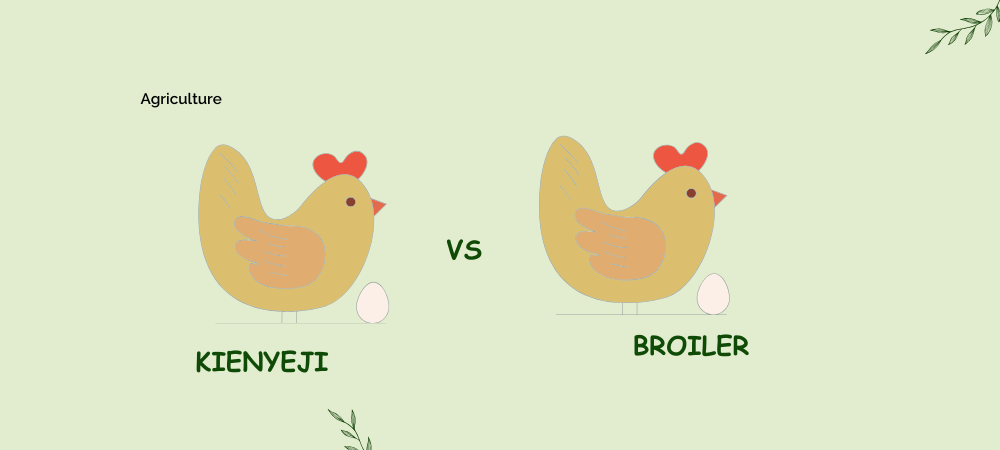
Broiler vs Kienyeji
When comparing these two poultry systems, profitability depends on several key factors:
1. Time to Market
Broilers clearly dominate in terms of speed. With a maturity period of 6–8 weeks, farmers can produce up to 5–6 cycles per year. In contrast, Kienyeji chickens take 4–6 months, limiting the number of cycles annually. If your goal is quick money, broilers have the advantage.
2. Cost of Production
Kienyeji chickens are far cheaper to raise. Their ability to scavenge reduces feed costs significantly, while broilers rely entirely on commercial feeds, making them expensive to maintain. High feed prices in Kenya can drastically affect broiler profitability.
3. Risk Level
Broilers carry higher risk due to their sensitivity to diseases and environmental changes. A small mistake in management can lead to heavy losses. Kienyeji chickens are more resilient, making them safer for farmers with less experience.
4. Market Demand and Pricing
Broilers have a large and consistent market, especially in urban areas, but they are sold at relatively lower prices due to high supply. Kienyeji chickens, on the other hand, are sold at premium prices, though demand is more niche and sometimes less predictable in bulk.
5. Profit Margins
While broilers generate profit through volume, Kienyeji chickens generate profit through higher margins and lower costs. In many cases, Kienyeji farmers retain more profit per bird despite slower turnover.
6. Capital Requirements
Broiler farming requires significant startup capital for chicks, feeds, vaccines, and controlled housing. Kienyeji farming is more flexible and can be started with minimal investment, making it accessible to small-scale farmers.
Which is More Profitable in Kenya?
There is no one-size-fits-all answer. Profitability depends largely on your location, resources, and market access. If you are located near an urban center and can supply hotels, restaurants, or supermarkets consistently, broiler farming can generate fast and high-volume profits.
If you are in a rural or semi-urban area with limited capital, Kienyeji farming offers lower risk and higher long-term returns per bird.
Most farmers combine both systems—using broilers for quick cash flow and Kienyeji for steady income and diversification.
Best Choice for Beginners
For beginners, improved Kienyeji chicken farming is the better starting point. It requires less capital and has lower risk. New farmers often lack experience in disease control and feeding programs —areas where broilers demand precision.
Starting with Kienyeji allows you to learn poultry management gradually while still earning income. Once you gain experience, you can expand into broiler farming for faster returns and scale your business.
Final Thoughts
Both broiler and Kienyeji farming are profitable in Kenya when done correctly. The key to success is not just the breed you choose, but your management skills. Farmers who understand their target market and align their production accordingly are the ones who achieve consistent profitability.
If you want fast money and can manage high input costs go for broilers. If you want sustainability, lower risk, and higher margins Kienyeji is the smarter option—especially for beginners.